Tuesday, May 1, 2012

Sunday, April 22, 2012
Wednesday, March 28, 2012
PERU 2012 - Our Journey Through Peru

The
solid black lines are where we traveled by car and bus. The dotted
black lines are where we traveled by plane. The double black lines are
where we traveled by boat.
Sunday, March 25, 2012
PERU 2012 - Machu Picchu: Claiming the Inca Empire for Jesus
 Aguas Calientes, Peru
Sunday, March 25, 2012
.
Machu Picchu: Claiming the Inca Empire for Jesus
I
feel blessed beyond measure that our team was able to travel to Machu
Picchu, which is considered one of the "seven wonders of the world." We
flew from Lima to Cusco last week and stayed two days in order to get
acclimated to the elevation of 10,000 feet. From Cusco we took a bus two
hours north, then hopped on a train for another hour and a half and
arrived at the city of Aguas Calientes. We stayed at a nice hotel, but
were only able to get a few hours of sleep since we were wanting to
travel to Machu Picchu early in the morning in order to watch the
sunrise over the ruins. So at 5:30 am we boarded another bus that would
take us a half an hour up the mountains to Machu Piccu.

.
The
only word to describe the ancient city of Machu Picchu is breath
taking. We were able to climb different trails in order to get different
views of the ruins and also explored the ruins. As a part of our group
package deal, we were able to take a guided tour of Machu Picchu. Our
guide was a Quechua man who filled us in on the very interesting history of Machu Picchu as well as the Inca civilization itself.


.
The
city of Machu Picchu was discovered in 1911, and was most likely built
in the 1500's. Machu Picchu is one of one hundred Inca sites, all which
have a tremendous amount of importance to the indigenous people

.
All
of this insight into the Inca empire caused our team even more so
desire to worship, take communion and in unity usher in the Kingdom of
God into the region. And this is just what we did. We believe that the
strongholds of the area were confronted as we pleaded the blood of
Christ over the land. We sang together. One of our team members had a
song that God had given her to sing at the top of Machu Picchu. She also
heard from God that we should shout a call and response from Machu
Picchu. It went like this, "Who enters the gates?" The response being,
"The Lord strong and mighty! The Lord mighty in battle!" Our team linked
arms and yelled this chant at the top of our lungs. As we did this, a
security guard came and blew his whistle in our faces ordering us to
stop. He said that we were yelling like crazy people. Full of laughter,
we responded, "Somos locos por Jesucristo," or in English, "We are crazy
people for Jesus Christ!" We saw the security guards heart melt with
the love of Jesus as we hugged him and loved on him. What a great way to
end our day at Machu Picchu. Heaven knows the full extent of what took
place as our team gathered in warfare prayer on behalf of the indigenous
people who have been in bondage for centuries.
.
Christian Young


Wednesday, March 21, 2012
Tuesday, March 20, 2012
PERU 2012 - Lost in the Amazon: Search for the Unreached Ashaninka Tribe
 Nuevo Nazareth, Peru
Tuesday, March 20, 2012
.
Lost in the Amazon
After two days in Caco, our team prepared to head back out onto the Ucayali River to make contact with the unreached Ashaninka tribe and stay in their village. We had thought it was all planned out. Pastor Antonio said that he had received permission from the chief in an Ashaninka village for us to visit them. We had also thought we would only need Pastor Antonio’s boat to get there. After loading ourselves and our belongings onto the boat and traveling over an hour upriver, we pulled in to another Shipibo-Konibo village called, “Nuevo Nazareth.” Pastor Antonio’s cousin was the pastor in this village. To our surprise, we were informed that we could not make it to the Ashaninka village in one boat and that we would need to spend the night in this village, and the pastor would bring his boat as well. Conveniently, another church service was convened for us to lead. A pattern was developing. We would hear one thing and another thing would take place. This was a bit frustrating to say the least. Extending grace, our team agreed and stayed the night, bringing the glory of God to another Shipibo-Konibo language.
.
The next morning we loaded both boats and headed even further upriver seven hours. Somehow, our boats got separated and Pastor Antonio who was captaining our boat became lost in the Ucayali tributaries. We were lost for about four hours, navigating the river and following golden butterflies which we believed had been sent by God to guide us. Our team wasn’t too worried, but time was against us as it was getting dark and fear began to arise within Pastor Antonio and his son. Finally we heard our other team mates on the other boat close by on the river. We were relieved at this, but heard shouts from them that they needed help.
.
The reason they were asking for help began to unfold. Their boat had made it further up river, only 45 minutes from the Ashaninka village. Then, some Ashaninka loggers from that village chased down their boat and began to interrogate them. When asked why the team was going to the village, the local pastor replied that we were wanting to plant a church there. This of course was a foolish thing to say and was a part of his agenda, not ours. They then scolded the pastor and the team, telling them that they weren’t welcome and didn’t want a church. Liney tried to clarify our teams intentions to simply visit the tribe, learn about their culture and make friends. To that the loggers were much more willing to accept. But at that point it was too late. The loggers warned the pastor about a fiesta that was happening where the tribe always is drunk and violent, and that they had killed other foreigners who had tried to visit the villages. This of course didn’t phase our team, as we had heard from God to visit the Ashaninka people. But the pastor refused to take them further in his boat, turned around and wouldn’t talk to our team members. This is what our friends on the other boat were asking for help with.
.
Jesse, the team and I on our boat immediately came into agreement with our team on the other boat and put our foot down, saying that we were supposed to go to the Ashaninka tribe in spite of the risks. The loggers had also said that the chief was in Pucallpa and we wouldn’t have permission to talk with the tribe unless he was there, yet we had been informed that we were cleared by the chief to visit. Again, things that had been said to us before weren’t panning out. Both pastors vehemently opposed us in our desire to continue on 45 minutes to the Ashaninka village. After a battle over this, we finally had came to the conclusion that we were on their boats and we realized they weren’t going to budge. A spirit of fear, religion and pride were thick all around us in the local Shipibo-Konibo pastors. I was freakin’ pissed off that the enemy was having his way in this, yet our hands were tied. Being only 45 minutes from the Asheninka tribe, we turned around and headed another seven hours back to Nuevo Nazareth in the dark, using large flashlights to guide us and dodging large crocodiles on the river. But before we began to head back a rainbow appeared in the sky right over where the Ashaninka village is. I felt that it was God’s promise that He desires for that tribe not to be destroyed but to be saved, and that we would send missionaries back to them.
.
Christian Young


Wednesday, March 14, 2012
PERU 2012 - Ministry Among the Shipibo-Konibo People
 Caco, Peru
Wednesday, March 14, 2012
.
Ministry Among the Shipibo-Konibo People
We
boarded a boat in Pucallpa that would take us 16 hours up the Ucayali
River to the Shipibo-Konibo villages. We all hung our hammocks in the
middle of the boat and slept through the night as the boat cruised along
the river. All of this was after witnessing one of the most
breath-taking sunsets from the top of the boat.
.
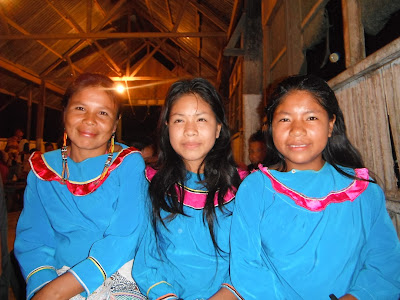
We
arrived in Pastor Antonio's village called, "Caco." This Shipibo-Konibo
village has a population of 1,200 people. Their simple homes and muddy
roads, mixed in with many mosquitoes, gnats and biting flies made us
very aware that we were in a remote area of the Amazon Basin
.
After
visiting house to house in the village of Caco and praying for the
sick, we held a second church service that night. the tension was thick.
It was as if the enemy knew his grip was being loosened from the
people's lives. Thirty people came to Christ and many more were healed.
Then we confronted them with the need to publicly repent from going to
the shaman and practicing withcraft. Three of us were physically
attacked by a demonic spirit during this time and Jesse said that there
were people doing witchcraft against us in the church service. God was
victorious! Almost the entire church gathered and publically repented
from witchcraft and we prayed for the baptism of the Holy Spirit over
them. Thank you Jesus! We heard reports from Pastor Antonio that the
entire village felt the presence of God after our arrival and ministry
among the Shipibo-Konibo people. Now we pray that this fire spreads to the surrounding Shipibo-Konibo villages.
.
Christian Young


Subscribe to:
Posts (Atom)